
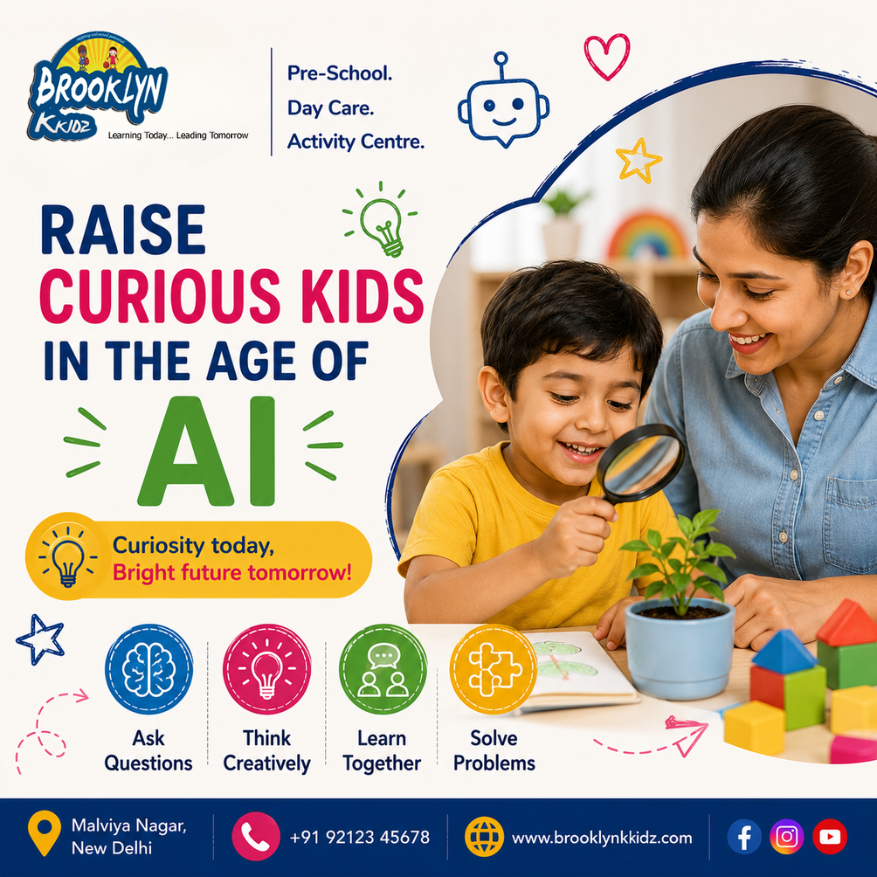
How to Raise Curious Kids in the Age of AI
Artificial intelligence is becoming a part of everyday life, from search engines and educational tools to smart assistants and AI-powered learning platforms. As technology becomes more accessible, parents are facing a new question: how can we help young children grow up with technology without allowing technology to replace curiosity, creativity, and real human interaction?
For preschoolers, the answer is not simply giving them more technology. The most valuable skills at this age are curiosity, communication, imagination, problem-solving, emotional intelligence, and the confidence to explore the world around them. Current conversations around parenting and early education are increasingly focusing on helping children become independent thinkers rather than simply consumers of instant answers.
Why Curiosity Matters More Than Ever
AI can provide an answer almost instantly, but knowing an answer is not the same as understanding it. Young children need opportunities to ask questions, experiment, make mistakes, and discover solutions on their own.
When your child asks, “Why is the sky blue?” instead of immediately giving an answer, try asking, “What do you think?” This simple change encourages children to observe, imagine, explain, and develop their own ideas.
Encourage Questions Instead of Giving Instant Answers
Preschoolers ask countless questions because they are naturally curious. Rather than seeing these questions as interruptions, parents can use them as opportunities for learning.
Ask follow-up questions such as “What do you think will happen?”, “How could we find out?”, or “Why do you think that happened?” These conversations help children develop reasoning skills while making them active participants in learning.
Make Hands-On Learning a Daily Habit
Technology should never replace real-world experiences during the early years. Building with blocks, drawing, painting, gardening, cooking, solving puzzles, playing outdoors, and exploring nature give children opportunities to learn through their senses.
These simple experiences encourage children to observe cause and effect, solve problems, communicate ideas, and experiment independently. Play-based and activity-based learning remain central to early childhood education because they support holistic development and school readiness.
Let Children Make Mistakes
In a world where technology can quickly correct mistakes, children still need the freedom to get things wrong. Mistakes are an important part of learning.
If a tower made from blocks falls down, don’t immediately rebuild it for your child. Ask, “What could we change next time?” This encourages persistence, creativity, and problem-solving while teaching children that mistakes are opportunities to learn.
Build Creativity Through Storytelling
Storytelling is a simple way to develop imagination in an increasingly digital world. Instead of always playing a ready-made story on a device, create stories together.
Start with a simple character and ask your child to decide where the character goes, what happens next, and how the story ends. This encourages language development, imagination, memory, and independent thinking.
Balance Technology With Real-Life Experiences
Technology can have a useful role in children’s learning when it is age-appropriate and thoughtfully used. However, young children also need face-to-face conversations, physical activity, creative play, outdoor exploration, and time with family.
Emerging approaches to early childhood education are increasingly emphasizing purposeful technology use with clear boundaries rather than simply increasing children’s screen exposure.
Teach Children That AI Is a Tool, Not a Replacement for Thinking
As children grow older, they will encounter AI in education, entertainment, communication, and everyday life. One of the most valuable lessons parents can teach is that technology can help us explore ideas, but we should still think, question, and make decisions ourselves.
For preschoolers, this lesson can begin with simple everyday activities. Encourage them to predict outcomes, explain their choices, compare objects, create their own stories, and solve problems before offering help.
The Role of Preschool in the Age of AI
A good preschool environment should prepare children not only for today’s classroom but also for tomorrow’s world. This means developing curiosity, communication, creativity, collaboration, emotional intelligence, and problem-solving alongside early academic skills.
At Brooklyn Kkidz, we believe children learn best when they can explore, ask questions, interact with others, and learn through meaningful experiences. Our focus on play-based and activity-based learning gives children opportunities to develop the confidence and curiosity they need for a rapidly changing future.
Conclusion
The goal is not to keep children away from technology forever. It is to make sure technology never takes the place of curiosity, creativity, relationships, and real-world discovery.
In the age of AI, children who know how to ask questions, think independently, communicate their ideas, solve problems, and remain curious will have an important advantage. The best preparation begins with something very simple: give children time to explore, encourage their questions, and let them discover the answers.
Frequently Asked Questions (FAQs):
How does AI affect preschool education?
AI is beginning to influence early childhood education through personalized learning tools and educational resources, but young children still benefit greatly from hands-on play, conversations, relationships, and real-world experiences.
Should preschool children use AI?
Parents should consider age-appropriate technology carefully and prioritize supervised, purposeful use. For young children, AI should not replace play, social interaction, creative activities, reading, or outdoor experiences.
How can parents develop critical thinking in preschoolers?
Parents can ask open-ended questions, encourage children to explain their ideas, allow them to solve simple problems, and give them opportunities to experiment and learn from mistakes.
What skills will children need in an AI-driven future?
Curiosity, creativity, communication, collaboration, emotional intelligence, adaptability, and independent thinking will remain important even as technology becomes more advanced.
Why is play important in the age of AI?
Play gives children opportunities to imagine, experiment, communicate, make decisions, solve problems, and interact with others—skills that technology alone cannot fully replace.