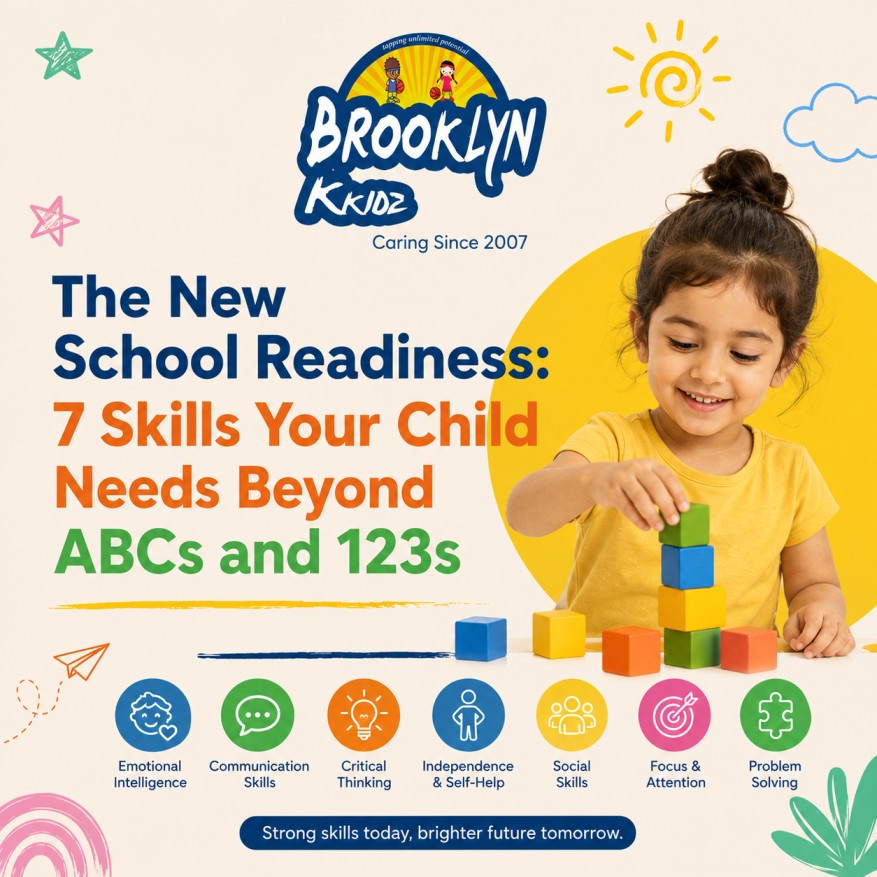
The New School Readiness: 7 Skills Your Child Needs Beyond ABCs and 123s
When parents think about preparing their child for school, the first things that often come to mind are alphabets, numbers, colours, shapes, and writing. These early academic skills are certainly useful, but being ready for school involves much more than knowing ABCs and 123s. A child also needs to communicate, make friends, follow routines, manage emotions, solve simple problems, and feel confident enough to try new things.
Modern school readiness is about preparing the whole child. The preschool years provide an important opportunity to develop the social, emotional, physical, communication, and thinking skills that help children feel comfortable and confident when they enter a formal classroom.
What Does School Readiness Really Mean?
School readiness means that a child has developed a combination of skills that helps them participate successfully in a learning environment. It does not mean that a child needs to know everything before starting school. Instead, children should gradually develop the confidence and ability to listen, communicate, interact with others, manage everyday tasks, and participate in learning activities.
Every child develops at a different pace, so school readiness should not be treated as a race. A supportive environment at home and preschool can give children the opportunities they need to develop these skills naturally.
1. Communication Skills
Being able to communicate is one of the most important skills a child can have when starting school. Children need to express their needs, share ideas, answer questions, and tell adults when something is wrong.
Parents can encourage communication through everyday conversations, storytelling, reading, songs, and asking open-ended questions. Instead of simply asking questions that require a “yes” or “no,” encourage your child to explain what they see, what they think, and how they feel. These simple conversations build vocabulary, listening skills, confidence, and expressive language.
2. Emotional Awareness and Self-Regulation
A child entering school will experience excitement, frustration, disappointment, and many new situations. Learning how to recognise and manage emotions can make this transition much easier.
Children don’t need to control every emotion perfectly. They need to gradually learn that feelings can be expressed in healthy ways. Parents and educators can help by naming emotions, listening calmly, and teaching simple strategies such as taking a deep breath, asking for help, or taking a short break.
Emotional awareness helps children become more comfortable in classrooms and better prepared to handle everyday challenges.
3. Independence and Self-Help Skills
School becomes easier when children can manage simple tasks independently. Getting their bag, putting away toys, washing their hands, eating independently, wearing their shoes, or organising their belongings are small achievements that build confidence.
Parents can support independence by giving children age-appropriate responsibilities rather than completing every task for them. It may take a little longer initially, but allowing children to try helps them develop responsibility, confidence, and practical life skills.
4. Social Skills and Cooperation
School is a social environment where children interact with teachers and classmates every day. Knowing how to share, take turns, listen to others, cooperate during activities, and respect personal space helps children build positive relationships.
Social skills develop naturally through group play and everyday experiences. Parents can encourage children to play with other children, practise taking turns, and talk about how their actions affect others. Activities that involve teamwork can also help children understand cooperation and empathy.
5. Focus and Following Instructions
Children don’t need to sit perfectly still for long periods before starting school. However, developing the ability to listen, pay attention to an activity, and follow simple instructions is an important part of school readiness.
Parents can strengthen these skills through games such as “Simon Says,” simple puzzles, storytelling, matching activities, and multi-step tasks. Giving instructions one step at a time and gradually increasing the difficulty helps children develop attention and listening skills without making learning feel like a test.
6. Problem-Solving and Critical Thinking
School is not simply about remembering information. Children also need to think, explore, experiment, and find solutions. Problem-solving skills help children approach new situations with curiosity rather than immediately giving up.
Parents can encourage this development by asking questions such as, “What do you think we should try?” or “Is there another way?” Building blocks, puzzles, sorting games, pretend play, and simple household challenges can all provide opportunities for children to think independently.
Allowing children to make mistakes is equally important. When children discover solutions themselves, they develop persistence and confidence in their own abilities.
7. Confidence and Curiosity
Perhaps one of the most valuable school readiness skills is the willingness to try. A confident child is more likely to ask questions, participate in activities, make new friends, and explore unfamiliar experiences.
Parents can build confidence by celebrating effort rather than only praising correct answers. Saying, “You kept trying even when it was difficult,” teaches children that learning is a process. Encouraging curiosity through books, nature walks, creative activities, and hands-on exploration also helps children enter school with an enthusiasm for discovery.
ABCs and 123s Still Matter—But They Are Only the Beginning
Early academic knowledge has an important place in preschool education, but it should work alongside broader developmental skills. Recognising letters, counting objects, identifying shapes, and developing early writing skills can help children transition into academic learning, while communication, independence, emotional regulation, social interaction, and problem-solving help them participate successfully in the classroom.
The strongest preschool experiences create opportunities for children to develop both areas through meaningful and enjoyable activities.
How Parents Can Prepare Children for School at Home
School readiness does not require parents to turn their homes into classrooms. Everyday routines provide countless opportunities for learning. Reading a story together can develop language, asking your child to help organise toys can encourage responsibility, cooking together can introduce counting and measurement, and playing with other children can develop social skills.
Most importantly, give children opportunities to make choices and try things independently. A child who feels capable and supported is more likely to approach school with confidence and curiosity.
How Brooklyn Kkidz Supports School Readiness
At Brooklyn Kkidz, we believe that preparing children for school means nurturing every aspect of their development. Our learning environment encourages children to communicate, collaborate, explore, create, solve problems, and become increasingly independent while developing age-appropriate academic foundations.
Through play-based learning, storytelling, creative activities, group experiences, and hands-on exploration, children get opportunities to develop the skills they need beyond ABCs and 123s. Our goal is to help every child become a confident, curious, and happy learner who is ready to take their next step.
Conclusion
The definition of school readiness is changing. Knowing letters and numbers is helpful, but true readiness also involves confidence, communication, emotional awareness, independence, social skills, focus, curiosity, and problem-solving.
The preschool years are the perfect time to develop these abilities through play, conversation, exploration, and everyday experiences. When children are given the freedom to learn at their own pace and the encouragement to try new things, they don’t just become ready for school—they become ready to learn throughout life.
Frequently Asked Questions (FAQs):
What are the most important school readiness skills?
School readiness includes communication, emotional regulation, independence, social skills, attention, problem-solving, confidence, and early academic abilities such as recognising letters and numbers.
Does my child need to know ABCs before starting school?
Knowing some letters and sounds can be helpful, but children do not need to master the alphabet before starting school. Social, emotional, communication, and independence skills are equally important.
How can I prepare my child for school at home?
Parents can prepare children through reading, conversations, creative play, simple household responsibilities, puzzles, outdoor activities, group play, and routines that encourage independence.
At what age should parents start preparing for school?
School readiness develops gradually from the early years. Parents can support it through everyday interactions and play long before formal school begins.
How does preschool help with school readiness?
A quality preschool gives children regular opportunities to interact with peers, follow routines, communicate with teachers, solve problems, participate in group activities, and develop early academic skills in a supportive environment.