
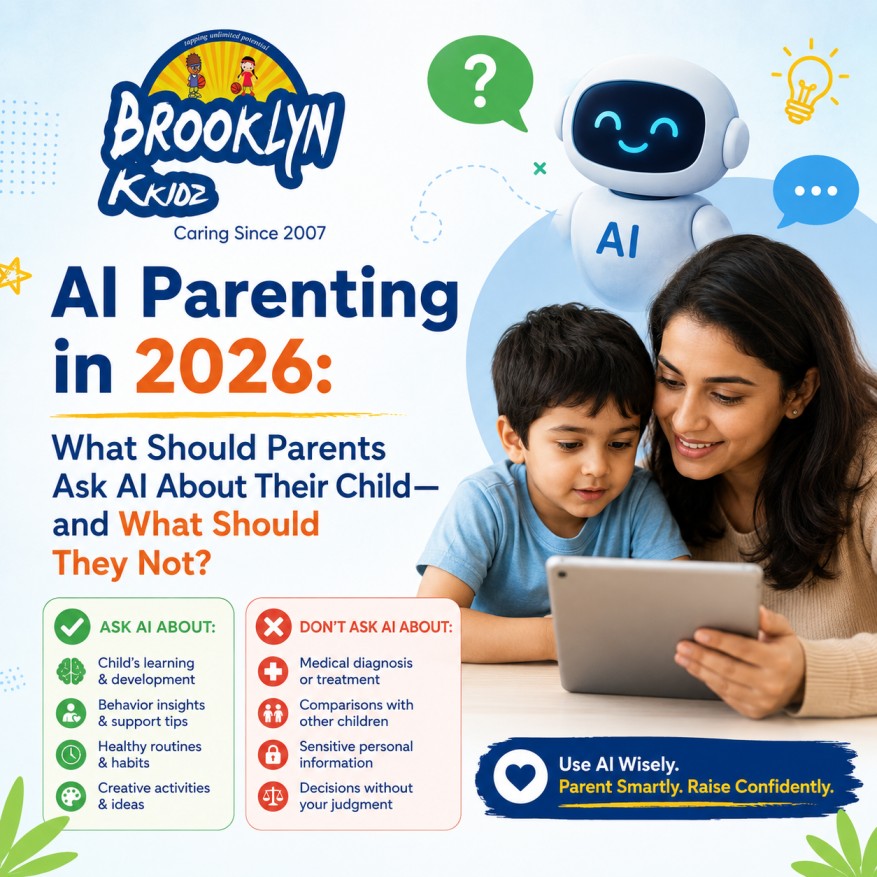
AI Parenting in 2026: What Should Parents Ask AI About Their Child—and What Should They Not?
Parenting has never come with a perfect instruction manual, but in 2026, parents have something new available at their fingertips: Artificial Intelligence. From suggesting bedtime routines and preschool activities to helping parents understand developmental milestones, AI tools can provide ideas and information within seconds.
But there is an important question every parent should ask before typing a question into an AI tool: Where can AI help, and where should a real human be involved?
For parents of preschoolers, this distinction is especially important. Young children learn through relationships, conversations, play, exploration, and emotional connection. AI can support parents with information and ideas, but it should never replace a parent’s judgement, a teacher’s understanding, or qualified professional advice.
Why AI Is Becoming Part of Modern Parenting
Parents today have access to more information than ever before, but having too much information can sometimes be overwhelming. A simple question about a child’s behaviour can produce thousands of search results, opinions, and conflicting suggestions.
AI can make this information easier to understand by helping parents organise ideas, generate activities, explain concepts, and prepare questions for conversations with teachers or professionals. Used thoughtfully, it can become a useful parenting assistant rather than another source of information overload.
What Parents Can Ask AI About Their Child
AI can be particularly useful for ideas, planning, learning, and everyday parenting support. Parents can ask AI to suggest age-appropriate activities that encourage language development, creativity, fine motor skills, problem-solving, or social interaction.
For example, instead of simply asking for entertainment ideas, parents can ask, “What are some screen-free activities for a four-year-old that encourage creativity?” The answer can provide starting points that parents can adapt according to their child’s interests.
AI can also help parents create storytelling ideas, simple learning games, conversation starters, craft activities, indoor play ideas, and routines that make everyday learning more enjoyable.
Use AI to Encourage Curiosity, Not Replace It
One of the biggest opportunities for AI in parenting is helping adults create better learning experiences. However, parents should be careful not to turn AI into an instant-answer machine for children.
If a child asks, “Why does the moon change shape?” a parent can use AI privately to understand the concept and then explain it in an age-appropriate way. Even better, parents can encourage the child to observe the moon, draw what they see, and make their own predictions.
The objective should be to use AI to support curiosity, rather than removing the opportunity for children to wonder, experiment, and discover.
AI Can Help With Preschool Learning Ideas
Parents can also use AI to generate ideas that complement what children are learning at preschool. If a child is learning colours, shapes, animals, numbers, or simple vocabulary, AI can suggest games and activities that reinforce those concepts at home.
For example, a parent could ask for a five-minute counting game using household objects. The resulting activity could turn everyday items such as spoons, toys, or fruits into a fun learning experience.
This keeps the child actively involved instead of simply placing them in front of another screen.
What Parents Should Be Careful About Asking AI
AI should not become the final authority on a child’s health, mental well-being, development, safety, or individual needs. If a parent is worried about a child’s physical symptoms, speech development, behaviour, emotional well-being, sleep, nutrition, or developmental progress, AI may provide general information, but it cannot replace an appropriate professional assessment.
Every child develops differently, and an AI response based on general information may not understand the child’s complete situation. When something genuinely concerns a parent, speaking with a qualified professional is the safer approach.
Don’t Ask AI to Diagnose Your Child
One of the biggest mistakes parents can make is treating an AI response as a diagnosis.
Searching for symptoms and immediately assuming that a child has a particular condition can create unnecessary fear or confusion. AI can help parents understand general terminology or prepare questions for a doctor, psychologist, speech therapist, or other qualified professional, but diagnosis requires appropriate professional evaluation.
A useful approach is to ask AI, “What questions should I ask my child’s doctor about this concern?” rather than “Does my child have this condition?”
Be Careful With Your Child’s Personal Information
Privacy is another important consideration when using AI for parenting. Parents should think carefully before entering their child’s full name, address, school details, photographs, medical records, or other highly personal information into an AI system.
Instead of sharing identifying details, parents can describe a situation generally. For example, they might say, “My four-year-old is having difficulty sharing with other children,” without providing information that could identify the child.
Good digital parenting includes teaching children that personal information should be protected online, just as it is in the real world.
Don’t Let AI Replace Parent-Child Conversations
AI can generate a bedtime story, but reading that story together is still a valuable human experience. AI can suggest questions, but asking those questions while sitting with your child creates connection. AI can provide activity ideas, but playing together creates memories.
For preschoolers especially, facial expressions, tone of voice, physical interaction, encouragement, and emotional reassurance are important parts of learning. Technology can provide information, but relationships provide security and belonging.
Parents Still Need to Trust Their Own Understanding
AI may sound confident even when an answer is incomplete or inappropriate for a particular situation. Parents should therefore treat AI-generated information as a starting point rather than an unquestionable answer.
Cross-check important information, consider the child’s individual circumstances, and use professional guidance when necessary. A parent’s knowledge of their child’s personality, behaviour, interests, and everyday experiences remains incredibly valuable.
How AI Can Support Independent Thinking
Interestingly, AI can also be used to help children become better thinkers—if adults use it carefully.
Instead of asking AI to solve every problem immediately, parents can first encourage children to think for themselves. Ask, “What do you think?” “Why do you think that happened?” or “What could we try next?”
This approach ensures that technology supports thinking rather than replacing it. In a future where AI can provide answers instantly, the ability to ask good questions and think independently may become even more valuable.
The Role of Preschool in an AI-Driven Future
Preparing children for the future does not mean teaching preschoolers to depend on technology. It means developing the human abilities that technology cannot replace easily: curiosity, creativity, communication, empathy, collaboration, resilience, and independent thinking.
At Brooklyn Kkidz, we believe young children learn best through meaningful interaction, play, exploration, creativity, and hands-on experiences. Our approach focuses on developing the whole child while creating a strong foundation for future learning in a rapidly changing world.
AI Should Be Your Parenting Assistant, Not Your Parenting Replacement
The smartest way to use AI in parenting is to understand its role. It can help parents brainstorm activities, explain educational concepts, organise ideas, create stories, and prepare questions. But important decisions about a child’s health, safety, emotional well-being, and development should involve parents and appropriate professionals.
Most importantly, children still need something no AI can genuinely replace: a parent’s time, attention, encouragement, and love.
Conclusion
AI is becoming an increasingly useful part of modern family life, and parents can benefit from using it thoughtfully. The key is knowing what to ask and what not to outsource.
Use AI for ideas, information, planning, and inspiration. Use teachers and qualified professionals for specialised guidance. And use your own relationship with your child to understand what they need most.
The future of parenting does not have to be humans versus technology. The better future is humans using technology wisely while keeping curiosity, connection, and childhood at the centre.
Frequently Asked Questions (FAQs):
Can parents use AI for preschool learning activities?
Yes. Parents can use AI to generate age-appropriate ideas for storytelling, art, counting games, puzzles, sensory play, outdoor activities, and other learning experiences. These suggestions should complement real-world interaction rather than replace it.
Can AI tell me if my child has a developmental problem?
AI can provide general information about developmental topics, but it should not be treated as a diagnostic tool. If you have concerns about your child’s development, speak with an appropriately qualified professional.
Is it safe to share my child's information with AI?
Parents should avoid unnecessarily sharing identifying or sensitive information about their children. When possible, describe situations without including names, addresses, school details, photographs, or other personal information.
Should children use AI directly?
For preschool-aged children, adult involvement is important. Parents can use AI behind the scenes to create activities and learning ideas while keeping children’s main learning experiences focused on play, conversation, exploration, and real-world interaction.
How can AI help parents without replacing them?
AI can save parents time by helping brainstorm activities, explain concepts, organise routines, and generate creative ideas. The parent remains responsible for understanding the child’s individual needs and making important decisions.