
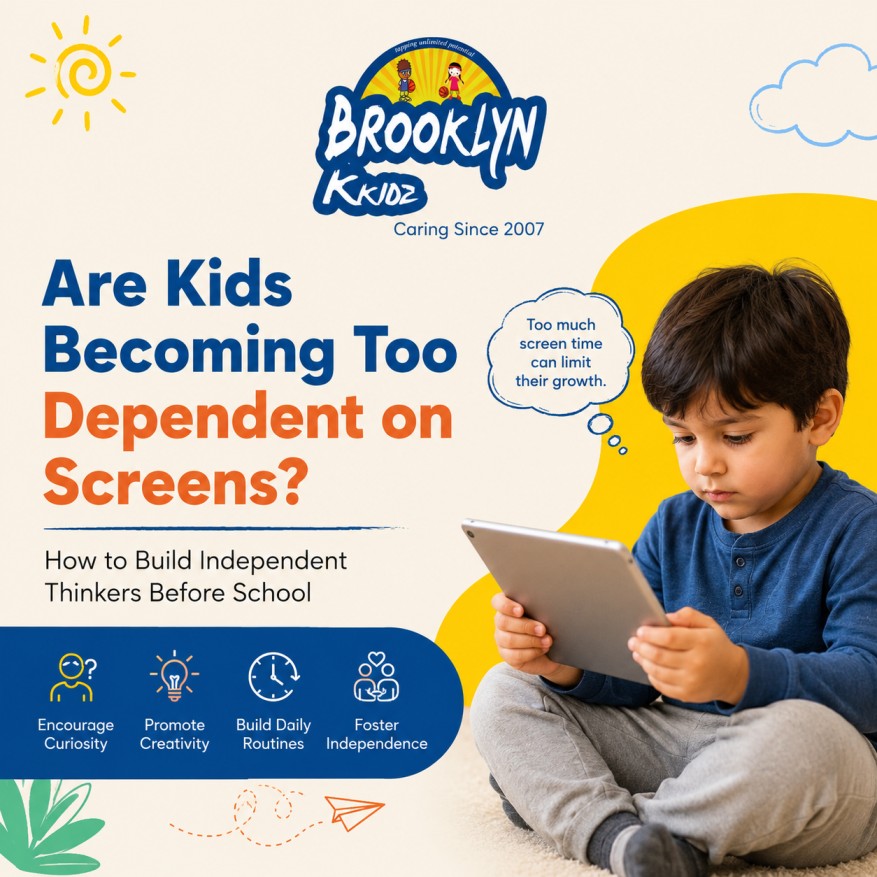
Are Kids Becoming Too Dependent on Screens?
Screens have become a normal part of childhood. Smartphones, tablets, televisions, and digital learning tools can entertain children and sometimes support learning, but too much dependence on screens can reduce opportunities for children to explore, communicate, create, and solve problems on their own. For preschoolers, these everyday experiences are extremely important because they are still developing the confidence and skills needed to become independent thinkers.
The goal is not to completely remove technology from a child’s life. Instead, parents can create a healthy balance where technology has a place, but real-world play, conversations, exploration, and independent discovery remain a major part of childhood.
What Does Screen Dependency Look Like in Young Children?
Screen dependency does not simply mean that a child enjoys watching cartoons or playing games. It may become a concern when a child regularly prefers a screen over playing, talking, exploring, or participating in everyday activities. Some children may become frustrated when a device is taken away, struggle to stay engaged without digital entertainment, or constantly ask for a phone or tablet whenever they feel bored.
Boredom itself is not necessarily a bad thing. In fact, moments of boredom can encourage children to invent games, explore their surroundings, create stories, and find their own solutions. Giving children space to experience boredom can therefore be an important part of developing independence.
Why Independent Thinking Matters Before School
Before children enter formal schooling, they are already developing important thinking habits. Learning how to make simple choices, ask questions, try something new, solve small problems, and recover from mistakes prepares children for classroom life and everyday challenges.
An independent thinker does not need to know everything. Instead, they learn to think, explore, ask for help when necessary, and try again. These habits can help children become more confident learners as they move from preschool into primary school.
Give Children Time to Solve Problems
One of the easiest ways to build independent thinking is to avoid solving every small problem immediately. If your child is struggling to complete a puzzle, build a tower, or open a box, give them a moment to try before stepping in.
Instead of saying, “Let me do it,” ask, “What could you try?” or “Do you have another idea?” Such simple questions encourage children to think about solutions rather than immediately depending on an adult or a device.
Replace Passive Screen Time with Active Play
Children need opportunities to use their bodies, hands, imagination, and senses. Building blocks, drawing, clay, puzzles, pretend play, music, gardening, and outdoor exploration can provide rich learning experiences without requiring a screen.
Active play also gives children the freedom to make choices. They can decide what to build, which colours to use, what role to play, or how to solve a challenge. These small decisions gradually strengthen confidence and independence.
Let Your Child Experience Healthy Boredom
Parents often feel that children should always be entertained, but constant entertainment can make it difficult for children to learn how to occupy themselves. When your child says, “I’m bored,” you don’t always need to provide a ready-made activity.
Give them time and space to discover something themselves. They might start drawing, create a pretend shop, arrange their toys, build something with blocks, or invent a completely new game. This is where imagination and independent thinking begin to develop naturally.
Encourage Questions Instead of Providing Instant Answers
Preschoolers are naturally curious and may ask questions throughout the day. Instead of immediately giving them every answer, encourage them to think about the question themselves.
If your child asks why a plant needs water, you might respond with, “What do you think will happen if we don’t water it?” This turns a simple question into an opportunity for observation, prediction, and discovery.
Make Everyday Tasks Learning Opportunities
Independence develops through everyday experiences, not just educational activities. Allowing children to put away their toys, choose between two outfits, help set the table, water plants, organise their books, or pack a small bag teaches responsibility and decision-making.
These tasks may take longer when children do them independently, but the learning experience is valuable. Instead of focusing only on efficiency, parents can focus on helping children gradually become capable and confident.
Don’t Be Afraid of Mistakes
A child who is never allowed to make mistakes may become afraid of trying something new. Mistakes are a natural part of learning and provide opportunities to develop resilience and problem-solving skills.
When something goes wrong, try asking, “What happened?” and “What can we try differently?” rather than immediately correcting the child. This teaches children that mistakes are not failures but opportunities to learn.
Create Screen-Free Family Moments
Creating predictable screen-free periods can help children become comfortable with activities that do not involve digital devices. Family meals, bedtime routines, outdoor walks, reading time, and creative activities can become natural screen-free moments.
Parents can also model these habits. When children regularly see adults putting phones aside to talk, read, play, or spend time together, they learn that real-world interaction is valuable.
Use Technology as a Tool, Not a Babysitter
Technology can be useful when it is intentional and age-appropriate. The key is to make sure screens do not become the automatic solution whenever a child is bored, upset, or waiting.
Parents can choose meaningful content, participate when appropriate, and create clear routines around device use. This helps children understand that technology is one part of life rather than the centre of it.
How Preschool Can Develop Independent Thinkers
A strong preschool environment gives children opportunities to make choices, explore ideas, work with others, and solve age-appropriate challenges. Teachers can encourage children to participate rather than simply provide answers.
At Brooklyn Kkidz, we believe that children learn best when they are actively involved in their learning journey. Through play-based activities, creative experiences, storytelling, group interaction, and hands-on exploration, children are encouraged to ask questions, express ideas, make choices, and develop confidence in their abilities.
Parents and Preschool Can Work Together
Building independence is most effective when children receive similar encouragement at home and at school. Parents can give children small responsibilities at home while educators provide opportunities for choice, teamwork, and problem-solving in the classroom.
When children experience this consistency, they gradually learn that they are capable of trying things themselves, asking thoughtful questions, and finding solutions rather than always waiting for someone else to provide an answer.
Conclusion
Screens are not the enemy, but excessive dependence on them can reduce valuable opportunities for children to explore the real world. The preschool years are an ideal time to develop curiosity, confidence, creativity, communication, and independent thinking through everyday experiences.
Parents do not need complicated strategies to get started. Give your child time to play, allow them to make choices, let them experience healthy boredom, encourage questions, and give them the opportunity to solve small problems independently. Less dependence on screens can create more space for children to think, explore, imagine, and grow.
Frequently Asked Questions (FAQs):
How can I tell if my child is becoming too dependent on screens?
If your child regularly demands screens, struggles to enjoy activities without them, becomes extremely upset whenever screen time ends, or chooses devices over normal play and interaction, it may be useful to reassess the family’s screen habits and routines.
How can I reduce screen time without constant arguments?
Gradual changes, predictable routines, advance warnings, and interesting alternatives can make transitions easier. Instead of simply taking a screen away, offer another engaging activity such as drawing, outdoor play, puzzles, or storytelling.
How can I make my preschooler more independent?
Give your child small age-appropriate responsibilities and choices. Let them try tasks independently, encourage problem-solving, and avoid immediately stepping in whenever something becomes difficult.
Is all screen time bad for preschoolers?
No. Screen time can sometimes be useful when content is age-appropriate and used intentionally. The important goal is maintaining a healthy balance between digital experiences and real-world play, learning, movement, and social interaction.
Why is boredom good for children?
Boredom can encourage children to use their imagination and create their own activities. It gives them an opportunity to make decisions, explore their interests, and develop independent play skills.