
As parents, we all want our children to grow smart, confident, and creative. But here’s the truth — brain development in early childhood doesn’t happen through books alone.
It happens through play, exploration, and simple daily activities.
The good news?
You don’t need expensive toys or classes.
In this guide, you’ll discover 10 powerful preschool activities you can do at home that actually improve your child’s brain development.
Why Early Brain Development Matters
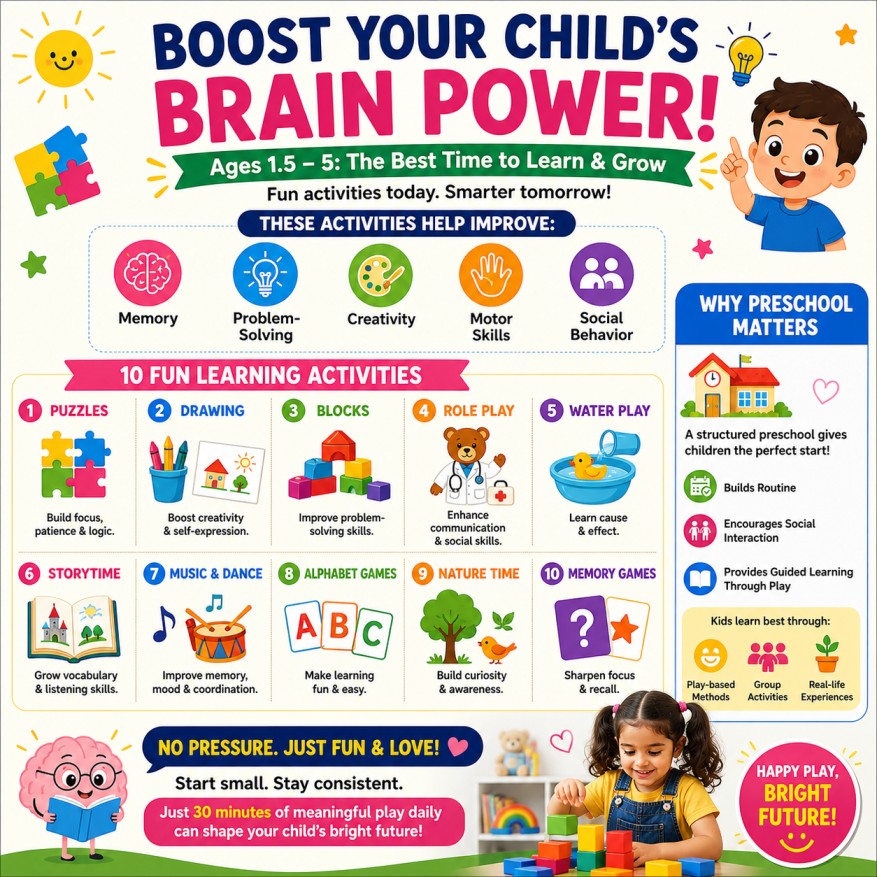
Between the ages of 1.5 to 5 years, a child’s brain develops faster than at any other stage of life. During this crucial period, the right activities can significantly enhance memory, strengthen problem-solving skills, boost creativity, improve motor skills, and support healthy social behavior.
10 Fun Preschool Activities:
🧩 Puzzle Play
Simple puzzles are a great way to improve a child’s logical thinking, patience, and focus. For younger kids, it’s best to start with large-piece puzzles so they can easily understand and enjoy the process.
🎨 Creative Drawing & Coloring
Providing children with crayons, paper, and complete freedom to express themselves helps boost their imagination and emotional expression. This activity allows kids to explore their creativity without any pressure.
🏗️ Building Blocks
Building blocks are more than just toys—they play a key role in developing spatial awareness and enhancing problem-solving skills as children learn to create and balance different structures.
🎭 Role Play (Pretend Play)
Encouraging children to act like a doctor, teacher, or shopkeeper helps improve their communication and social skills. Through pretend play, kids learn how to express themselves and understand real-life situations.
🧪 Water Play
Using simple items like cups, bowls, and spoons during water play helps children understand cause and effect while also introducing them to basic measurement concepts in a fun and interactive way.
📚 Storytelling Time
Reading stories daily supports vocabulary growth and improves listening skills. A great tip is to ask questions during storytelling, which helps children think, engage, and connect with the story better.
🎵 Music & Dance
Playing music and allowing children to dance freely improves their coordination, enhances mood, and strengthens memory. It also makes learning more enjoyable and energetic.
🔤 Alphabet Games
Using flashcards and letter-matching games makes learning alphabets fun and engaging. The key is to keep it playful rather than forcing the child, so they develop a natural interest in learning.
🌿 Nature Exploration
Taking children outdoors to observe trees, birds, and different colors helps build curiosity and awareness about the world around them. Nature becomes their first classroom.
🧠 Memory Games
Simple games like “What’s missing?” help improve concentration and recall ability. These activities strengthen a child’s memory while keeping them entertained.
Why Structured Preschool Still Matters:
While home activities are highly beneficial, a structured preschool environment plays an equally important role in a child’s development. It helps establish a daily routine, encourages social interaction, and provides guided learning experiences.
In a quality preschool, children learn through play-based methods, group activities, and real-life experiences that prepare them for future learning.
⚠️Children don’t need pressure to learn—they need the right environment filled with fun and meaningful experiences. Starting small and staying consistent can make a big difference.
Even just 30 minutes of focused, playful learning every day can positively shape your child’s future.
Frequently Asked Questions (FAQs):
1. Best preschool activities at home?
Puzzles, drawing, storytelling, and memory games.
2. How do activities help brain development?
They improve memory, creativity, and problem-solving skills.
3. Daily learning time for kids?
Around 30–60 minutes.
4. Why is play-based learning important?
It makes learning natural and stress-free.
5. Is preschool necessary?
Yes, it adds structure and social interaction.